
The Autonomous Workforce Is Here – and It Lives in Your ERP Stack
Something fundamental is shifting in how finance teams operate and most ERP partners are not yet selling into it.
It is not artificial intelligence as a concept. It is not automation in the traditional sense. It is the arrival of a genuinely autonomous digital workforce: software agents that perform complex, multi-step business processes without any human trigger, intervention, or approval. They monitor, decide, act, and complete entirely in the background, entirely without manual input, and entirely within the governance boundaries that finance leaders require.
This is not a future state. It is deployable today, with eight purpose-built autonomous bots, through a single platform that sits alongside any ERP without touching a line of custom code.
The question for every ERP partner reading this is not whether their clients need it. The question is whether they are the one who introduces it.
Automation and Autonomy Are Not the Same Thing
The distinction matters commercially and architecturally.
Traditional automation assists people. A workflow sends an approval notification. A macro populates a field. A scheduled report runs at midnight. In every case, a human trigger, a human decision, or a human action is either the starting point or a required step. Remove the human, and the process stops.
Autonomous processes are fully managed by bots, performing tasks without the need for human interaction, freeing time for strategic work. This is categorically different. The bot monitors, it decides based on defined parameters, it executes, it writes back results, and it moves on while the finance team is focused on something else entirely.
Whether it is supplier onboarding, sales order creation, regulatory compliance, or real-time data feeds from external platforms, UniFi’s autonomous bots handle the execution while the team focuses on what matters. Autonomous processes eliminate human error from routine tasks, deliver real-time data accuracy, and scale effortlessly as transaction volumes grow.
The difference in business outcome is significant. Automation reduces effort. Autonomy eliminates this process category entirely from the human workload.
The Eight-Bot Autonomous Arsenal – What Each One Actually Does
UniFi deploys eight purpose-built autonomous bots. Each one targets a specific class of manual work that currently consumes finance and operations teams across every ERP ecosystem.
1. Connect Hub – The Integration Layer
Connect Hub provides autonomous APIs pre-integrated into UniFi, including connections to Companies House, eCommerce platforms, and accommodation and travel services. These pre-configured connections can be used in new or existing apps without any technical setup. All external costs associated with these integrations are included in the bot licence.
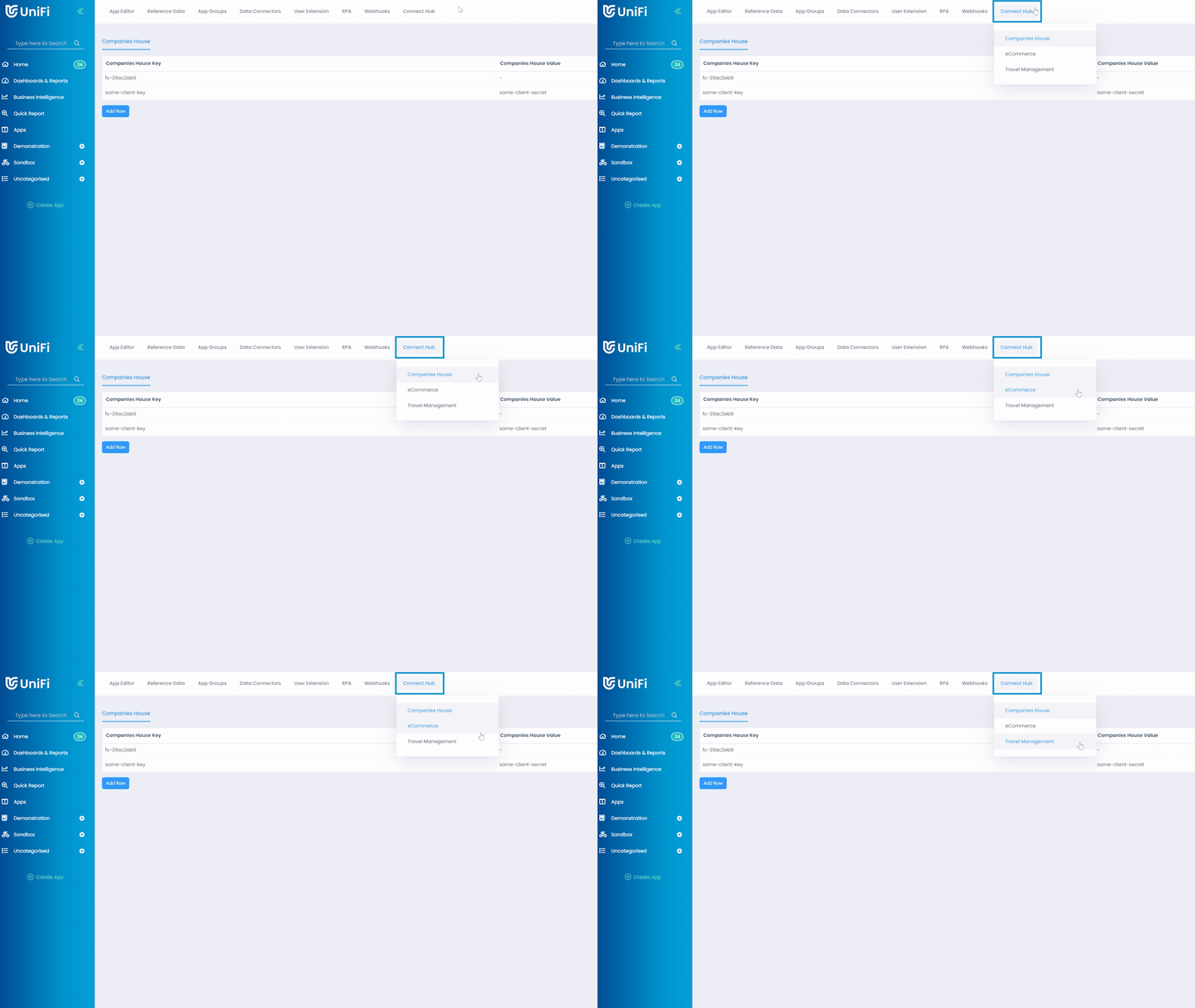
In practical terms: the Connect Hub is the autonomous gateway between the ERP and the outside world. It handles supplier validation via Companies House without a procurement team manually verifying company details. It processes eCommerce orders without a finance clerk re-keying sales data. It books and records travel without a PA in the loop.
Every ERP client has integration requirements. Others solve them with brittle custom middleware or expensive iPaaS subscriptions. Connect Hub replaces that with a pre-configured, bot-managed layer that carries zero upgrade risk.
2. Integration Bot – Data Orchestration
These bots handle incoming API connections to UniFi, enabling automated interactions with external systems. They can initiate or update transactions, but also add or modify reference data.
The Integration Bot is the autonomous translator between systems. When an external system sends data – a customer order, a payment confirmation, a stock level update – the Integration Bot intercepts it, validates it, transforms it to the correct format, and pushes it into the ERP without human intervention.
An example of real-world application: a customer places an order through their internal purchasing system. That order hits UniFi via API automatically. The Integration Bot creates the sales invoice, updates accounting records, and triggers fulfilment, all before a human has seen the transaction.
3. RPA Bot – Robotic Process Automation
The RPA Bot handles the repetitive, rule-based tasks that currently occupy the most hours in a finance team’s week. Invoice matching, automated ordering, cross-system data reconciliation, and payment status updates are just a few examples of processes the RPA bot can automate.
Robotic Process Automation automates repetitive tasks like invoice matching and automated ordering, enhancing efficiency, consistency, and freeing up time for higher-value work.
The RPA Bot does not just match invoices faster. It removes invoice matching from the human task list entirely. At scale across hundreds of transactions per day, this represents days of recovered capacity per month.
4. Generative AI Bot – Intelligent Personalisation and Decision Support
Generative AI extends beyond OCR to automate tasks like invoice coding and document authenticity analysis, streamlining workflows, reducing errors, and enhancing compliance.
The Generative AI Bot represents the frontier of autonomous finance capability. It analyses unstructured content; emails, documents, supplier communications – and takes action based on what it finds. It records invoices automatically by learning a client’s chart of accounts. It flags documents with authenticity concerns. It drafts personalised outreach based on real engagement data.
This is not a chatbot wrapper. UniFi’s machine learning layer continually refines how it reads and codes documents learning a company’s chart of accounts, recognising supplier formats, and getting smarter with every transaction processed.
5. Email Extraction Bot – Signal Intelligence
UniFi can monitor any email address and automatically create transactions from incoming mail. Attachments, such as invoices, are processed using advanced OCR and AI-powered machine learning tools, extracting key data and populating fields in the relevant app automatically. Once created, these transactions seamlessly progress to the next stage in the workflow without manual intervention.
For finance teams, email is where process goes to die. Supplier invoices arrive. Payment remittances are attached. Client queries land in shared inboxes. Each one requires a human to open, read, interpret, and act. The Email Extraction Bot monitors any email address, reads every incoming message, extracts the relevant data, creates the appropriate transaction, and routes it without a human touching the inbox.
6. Autonomous Data Capture – Next-Generation Document Intelligence
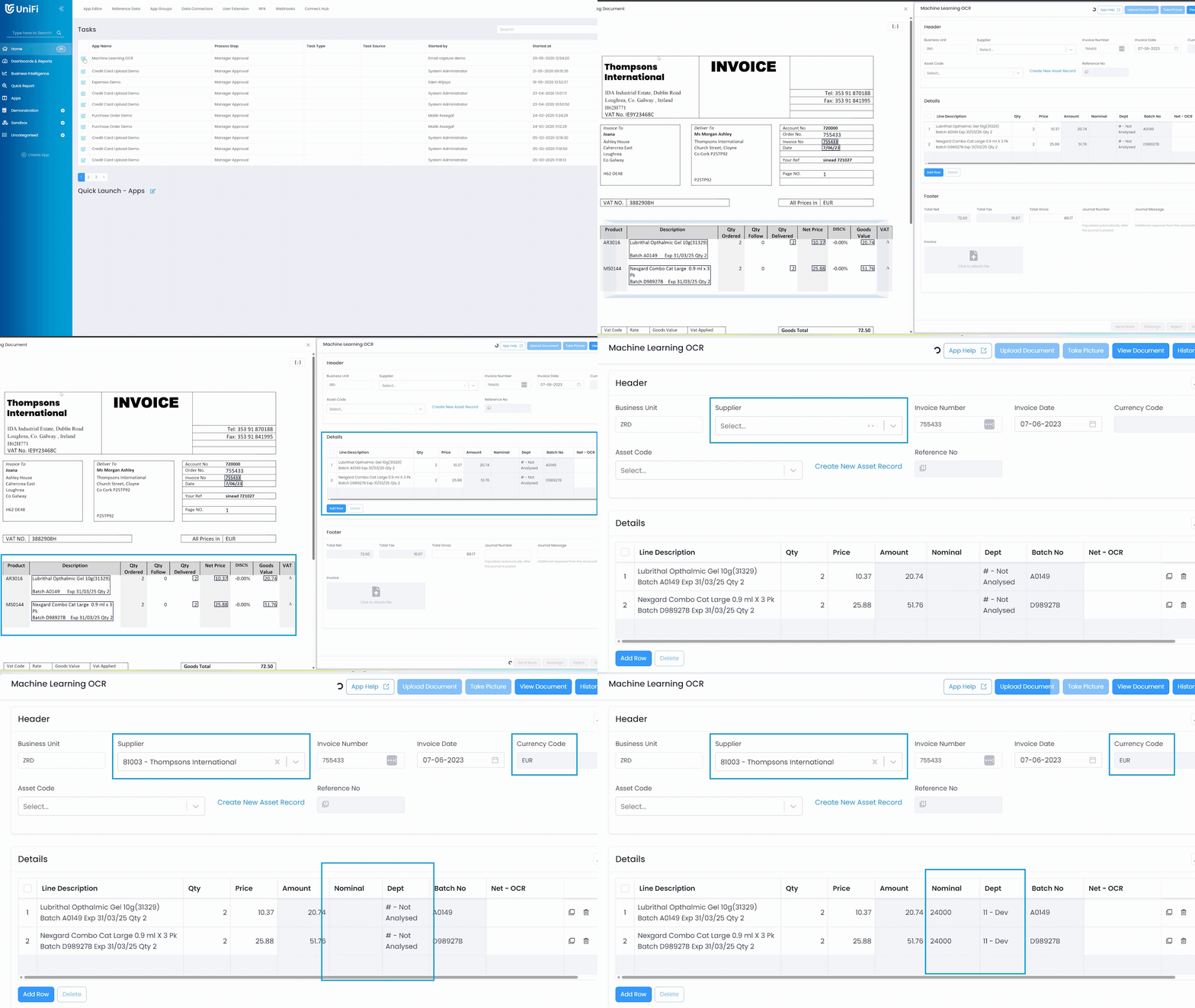
UniFi Autonomous Data Capture utilises powerful Machine Learning services to enable UniFi applications to harness AI power to extract text, handwriting, and data from scanned documents such as PDFs.
Traditional OCR is pattern-matching. It fails on unusual fonts, handwritten notes, or complex table formats. Autonomous Data Capture uses machine learning to understand context, not just characters. It recognises what a field means, not just what it says. It handles supplier invoices, identity documents, compliance forms, and financial statements with the same accuracy that a trained finance professional would apply – and it improves with every document it processes.
7. WebHook Bot – Event-Driven Trigger
The WebHook Bot fires the moment an external event occurs allowing you to get notified or perform an action as quickly as possible. Payment gateway confirms receipt – WebHook fires. Customer replies to an email cadence, WebHook fires. An eCommerce status updates to “delivered” and then, WebHook fires.
Webhooks in UniFi enable unauthenticated, one-way data transmission for immediate execution, ideal for non-critical processes like real-time notifications where response verification is not required. The business outcome: zero latency between external events and internal action. The gap between “something happened” and “the right thing was done about it” collapses to seconds.
8. Scheduler Bot – Workflow Orchestration
The Scheduler Bot is the conductor of the autonomous workforce. It determines when processes run, sequences dependent tasks, manages retry logic on failure, and ensures that time-sensitive operations i.e. month-end closes, dunning cycles, regulatory submissions execute exactly when they need to.
The Scheduler eliminates the human dependency from time-based processes entirely. No one needs to trigger the month-end close process. No one needs to remember to send the dunning run. The Scheduler ensures it happens and notifies the right person only when something requires human judgment.
The Use Cases Beyond AR and Sales
The Autonomous AR Hub and the Sales Outreach stack are two of the most commercially compelling packaged use cases, but they are far from the only ones.
The same eight bots, reconfigured for different process contexts, power:
Autonomous Accounts Payable: Email Extraction Bot monitors the AP inbox. Data Capture reads supplier invoices. Integration Bot validates supplier details via Connect Hub. RPA Bot matches purchase orders. Scheduler Bot triggers payment runs. The entire P2P cycle from invoice receipt to payment execution runs without a human in the data flow.
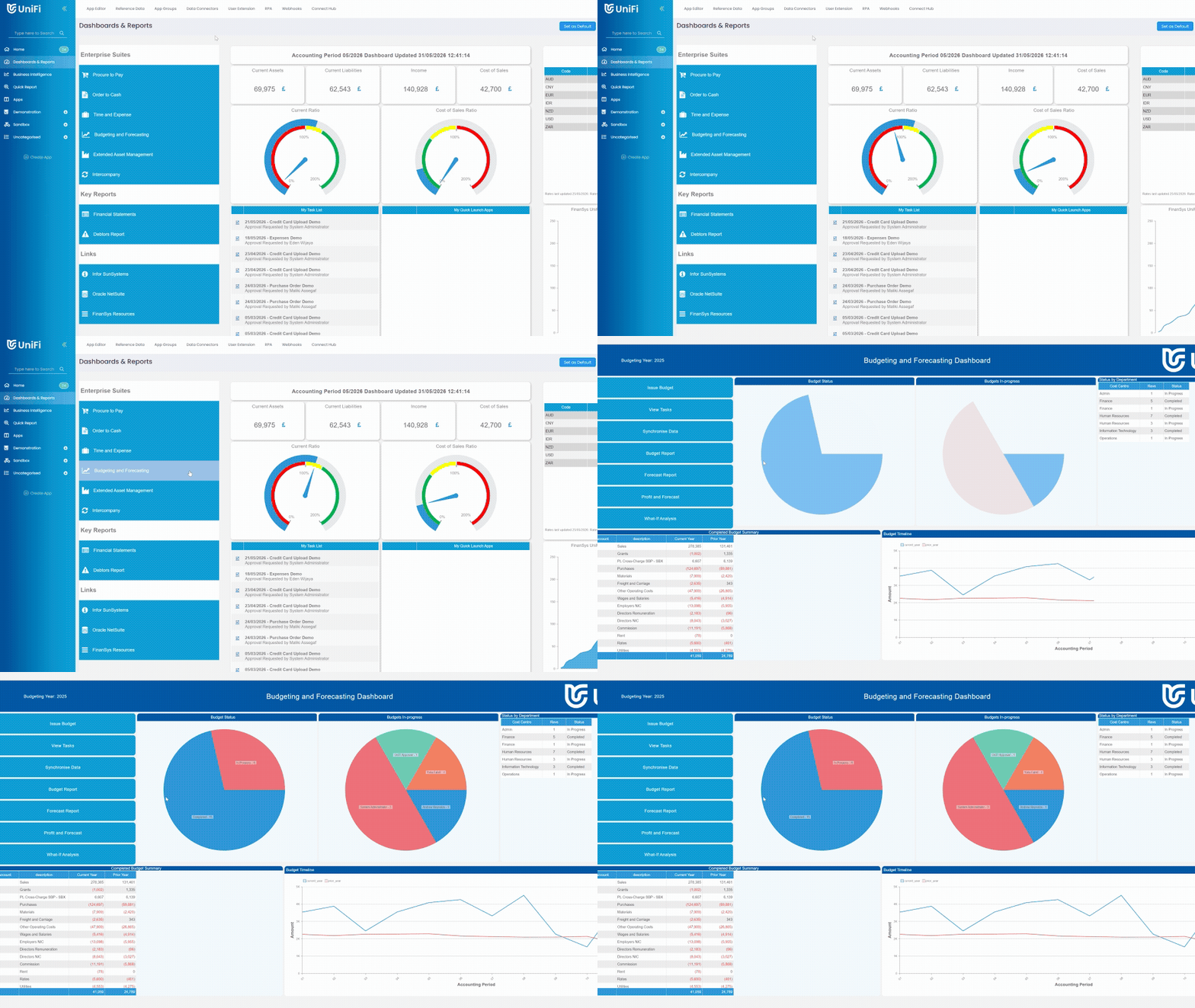
Planning, Budgeting, and Forecasting: Every process managed through Planning, Budgeting and Forecasting can be turned into an autonomous process and completed by a bot. Actuals feed automatically from the ERP. Variance analysis populates. Budget holders receive automated reports without the FP&A team spending two weeks compiling spreadsheets.
Autonomous Expense Management: Businesses that automate their expense systems see a 60% reduction in processing time and 35% lower operational costs. The Autonomous Data Capture Bot reads receipts. The Generative AI Bot validates policy compliance. The Integration Bot posts approved expenses to the ERP. The finance team sees a clean, reconciled ledger, not a pile of submissions to chase.
Exchange Rate Automation: Every process managed through Exchange Rates Automation can be turned into an autonomous process and completed by a bot pulling live rates, applying them to multi-currency transactions, posting revaluation entries, and generating FX exposure reports without manual intervention.
Supplier Onboarding and KYC: Connect Hub pulls Companies House data. The Generative AI Bot validates documentation. The Integration Bot creates the supplier record in the ERP. What previously took a procurement team three to five days of manual verification compresses to minutes.
eCommerce Order Processing: External orders arrive via API. The Integration Bot creates transactions. The RPA Bot matches stock availability. The Scheduler Bot triggers fulfilment. The finance team sees reconciled sales data in the ERP without anyone touching a keyboard between order and invoice.
The Clean Core Principle – Why This Architecture Matters
Every one of these autonomous processes runs outside the ERP core.
This is not incidental. It is architecturally intentional and commercially critical for ERP partners.
Custom scripts inside the ERP SuiteScripts, Dynamics extensions, or SAP modifications create technical debt that compounds with every upgrade cycle. Finance teams become dependent on developers to change business rules that should never have required IT involvement in the first place. Upgrade projects balloon in scope because the custom code breaks. Cloud migration stalls because the logic cannot be cleanly separated from the core.
UniFi Autonomous Processes run processes, features, and use cases in UniFi in the background or in front of the user, without the need to involve a human user. These advanced bots use UniFi’s powerful AI and Machine Learning capabilities to execute tasks with precision that matches human intelligence.
The ERP remains clean, standard, and upgrade-safe. The complexity lives in UniFi where it belongs, where finance teams can own it, and where changes can be made without raising a development ticket.
For ERP partners, this is the architectural argument that ends the customisation conversation. The choice is not “customise or don’t customise.” It is “where does the complexity live?” UniFi answers that definitively: outside the core, in a governed, auditable, upgrade-safe autonomous layer.
The Partner Opportunity – What This Means for Your Practice
Through the UniFi partnership model, partners leverage UniFi to build custom BPM applications, creating a holistic data environment. This allows an Autonomous Workforce to thrive by automating repetitive tasks while maintaining strict governance across disparate systems.
The commercial model is structured to maximise partner revenue at every stage:
New logo differentiation. 85% of competitive deals that include UniFi in the proposal result in a win. The Autonomous AR pitch, the Sales Outreach demonstration, the Accounts Payable transformation story; these are capabilities that no pure ERP implementation partner can match. Partners who carry UniFi enter a different competitive bracket.
100% professional services revenue. Every discovery engagement, every configuration project, every UAT cycle, every go-live, the implementation revenue belongs entirely to the partner. UniFi takes no share of the delivery economics. A standard autonomous AR deployment represents 10–18 days of billable consulting at partner rates.
Recurring SaaS margin. Partners retain 30% of every SaaS licence fee for the lifetime of the client relationship. A 12-user deployment generating £2,526 per year (gross partner price) returns £757 in annual recurring margin before a single hour of support is billed.
L1 support revenue. Partners own the first line of support relationship. Where billable hours are justified, they bill for them and retain 100% of that revenue.
Cross-sell depth. A partner who deploys Autonomous AR for a client has already established the platform relationship. Adding Autonomous AP, expense automation, or a planning module is a commercial conversation, not a technical one. Each additional use case is incremental PS revenue plus incremental SaaS margin on a client who already trusts the platform.
The Market Moment
Gartner predicts that by 2026, over 40% of enterprise applications will embed role-specific AI agents. The autonomous workforce is not an emerging trend. It is an accelerating expectation.
ERP clients are already being asked by their boards, by their auditors, by their CFOs, why their finance function still relies on manual processes that other organisations have eliminated. The question is not whether autonomous finance automation will become standard. The question is which ERP partner introduces it first to each client relationship.
UniFi is the only platform that automates accounting postings directly to the ERP not just approvals. Eight purpose-built autonomous bots. One platform. Limitless process redesign.
Every finance function. Every operational workflow. Every integration challenge. The autonomous workforce handles it while the people in those teams focus on the work that genuinely requires human judgment.
That is the proposition. That is the differentiation. That is the partner opportunity.
Simplify. Automate. UniFi.
Interested in deploying the Autonomous Workforce alongside your ERP practice? Visit partner.unifiplatform.com or contact sales@unifiplatform.com to explore the UniFi Authorised Channel Partner Programme.
